Library Collections are not Neutral
Hi All,
In reviewing Theme 3, Reference Materials, I was struck by three ideas: the importance of the online world to a library’s collection, the importance of having collection resources in multiple formats and serving multiple purposes, and the importance of examining the biases of the library collection itself.
Let’s examine the importance of the online world to our libraries. Some databases available through B.C. Digital Classroom are EBSCOhost (grades 4-8), EBSCOhost image search, EBSCOhost EBook collection, the Funk and Wagnalis New World Encyclopedia, Masterfile (with the full text of nearly 1700 periodicals), Explora Primary and Secondary, Consumer Health Complete, and NoveList K-8 Plus. This is far more information than could ever be housed in a school library. Moreover, as Richard pointed out in his notes, this is just the tip of the iceberg. He states “That there are 500 billion web pages (only 1/500 of that accessible by a typical search engine search)” (course notes, lesson 8). In order to provide meaningful reference services in the library, students must be taught how to search online (both the surface and deep web), must be provided with access to these resources, and these resources must be highly promoted to both students and staff (many teacher librarians in this course have commented on how underused online resources are).
The second point that I learned was the importance of having resources in multiple formats and for multiple purposes. Physical reference resources, for example, may work better for younger students unable to navigate online, while online resources allow older students to work from home, receive information more likely to have been recently updated, or be directly linked in to their word processing programs (Riedling 39, 63, 64, and 67). Paula Bernstein, in her article “Wikipedia and Britannica: The Kid's Aĺl Right (And So's the Old Man)”, also notes that “The good/better/best argument that some people make is worth considering” (Bernstein webpage). Wikipedia may, for instance, be the best resource to find an answer that you were arguing about with a friend while an encyclopedia may be better for a school research project. The right resource depends on what the searcher’s purpose is.
One further rabbit hole I wandered down was a blog written by Phoebe Ayers, a librarian and Wikipedia editor. She points out that “Wikipedia both serves as an instructive example and an inspiration not just to other reference works but to libraries in general: to make our biases visible, in specific and granular ways. Libraries are not neutral, but we often act as if we are” (https://wikipedia20.mitpress.mit.edu/pub/vj43a02q/release/16). The challenge for librarians is to think carefully about how our collections have been created – what information has been included and excluded, and which patrons have been made to feel welcomed or unwelcome as a consequence of this.
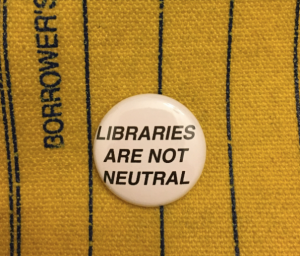
https://meredith.wolfwater.com/wordpress/2019/11/04/when-libraries-and-librarians-pretend-to-be-neutral-they-often-cause-harm/
Theme 3 has taught me that I must critically examine the choices I make as a teacher librarian – how are online resources being used, how is information being conveyed through different media forms, and how are the different individual reference needs of patrons being met by the collection?
Works Cited
Ayers, Phoebe, “Wikipedia and Libraries”. MIT Press, MIT, 10 June 2019, https://wikipedia20.mitpress.mit.edu/pub/vj43a02q/release/16
Bernstein, Paula. “Wikipedia and Britannica: The Kid's Aĺl Right (And So's the Old Man).” Information Today, Inc., Mar. 2006, https://www.infotoday.com/searcher/mar06/berinstein.shtml
Beaudry, Richard. “Lesson 8: Deep Web” [course notes]. Retrieved from https://canvas.ubc.ca/courses/108885/pages/lesson-8-digital-resources-the-web-and-grey-literature?module_item_id=5310101
Farkas, Meredith. When Libraries and Librarians Pretend to Be Neutral, They Often Cause Harm, 11 Apr. 2019, https://meredith.wolfwater.com/wordpress/2019/11/04/when-libraries-and-librarians-pretend-to-be-neutral-they-often-cause-harm/. Accessed 9 Apr. 2023.
Riedling, Ann Marlow. Reference Skills for the School Librarian: Tools and Tips. Libraries Unlimited, an Imprint of ABC CLIO, LLC, 2019.


Comments
Post a Comment